
Let’s face it, a lot of scientific research lands in esoteric journals and peer-attended conferences.
But at the westernmost point of Lake Superior, scientists have embedded themselves and their research in the community.
“We meet with teachers, principals, citizen groups … decision makers and elected officials,” said Ralph Garono, reserve manager at the Lake Superior Estuarine Research Reserve. “We see what community concerns are and find information to fill in those knowledge gaps.”
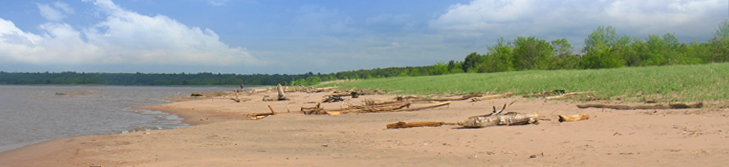
The Lake Superior reserve is a combination of four land areas and portions of connecting waterways in Douglas County, Wisc. Photo: NOAA
The reserve is one of 28 estuaries that the National Oceanic and Atmospheric Association designated for research, monitoring and community education. Most of the estuaries, which are partially enclosed waterways that dump into larger bodies of water, are ocean sites. The Lake Superior site and Old Woman Creek in Ohio are the only two in the Great Lakes.
Lake Superior reserve scientists study the usual Great Lakes issues — invasive species, pollution, habitat loss and climate change. But what’s unique is that the research is taken directly to the community, addressing local issues.
Stormwater runoff and pollution plague Superior, Wisc. It is one of the first issues the reserve is tackling.
“One thing we’re interested in is how different scenarios affect water flow,” Garono said. “We’re working with coastal decision makers, city council and county conservation people on it.”
And city officials are happy to have help.
“People do things to storm drains that they may not even think are bad, like mowing their lawn and letting clippings go into the drain,” said Diane Nelson, stormwater coordinator for Superior. “People need to know these things, and that’s where the reserve comes in.”
Nelson said that the reserve’s scientists and communicators have expertise that her department often doesn’t.
But they’re not just working with bureaucrats — they’re also in the schools.
“We take our research results, work with local teachers, and work our stuff into the K through 12 curriculum,” Garono said.
Reserve staff meets with teachers and principals to teach them about the local environment. Down the road, the reserve will invite students to do hands-on research.
The other Great Lakes estuary reserve, Old Woman Creek, is on the south central shore of Lake Erie, and also communicates local environmental research, said Frank Lopez, manager of the reserve.
“We have a K through 12 program, but we also train local officials and coastal managers,” Lopez said. “Planners, engineers … these people need to know what’s the latest news on the local natural resources.”
And for Lopez, it goes beyond educating, and entails fostering an appreciation for the area.
“We want to get people hooked on the resources … things like canoeing, kayaking,” Lopez said. “If you involve people, they care more.”
The Lake Superior Research Reserve received its federal designation in 2010. Garono thinks it’s because the location is so close to the Port of Duluth-Superior, making it environmentally unique.
“We have multi-use lakes, one of the largest industrial ports in the Great Lakes and then a large wetland just a few miles from each other,” Garono said.
The port handles about 42 million short tons of cargo from 1,000 vessel visits annually, according to the Duluth Seaway Port Authority.
“We have all of this crammed into such a small space,” Garono said. “We’re trying to optimize the system … we’re interested in both ecology and economy.”
The reserve covers approximately 16,700 acres. Old Woman Creek was designated in 1980, and covers 573 acres.
Nelson thinks educating leaders will be the reserve’s biggest impact.
“People get elected to city council and have to make decisions on water quality,” Nelson said. “The problem is a lot of them lack that expertise … and that’s where the reserve can step in.”
Although they work with policymakers, both Garono and Lopez were quick to point out that they stop short of lobbying — they let the research do the talking.
“We talk to legislators and make sure they have the information they need,” Lopez said. “The research should really point out the correct course of action.”