
By SHANNAN O’NEIL
Capital News Service
LANSING- Some Michigan landfills would only need one instead of two liners to keep them from contaminating the environment under proposed legislation.
Currently Michigan landfills are required to have two liners to prevent leakage of fluids that could contaminate the water. A bill introduced by Rep. Andrea LaFontaine, R-Richmond, would make it unnecessary for certain landfills to have the second liner.
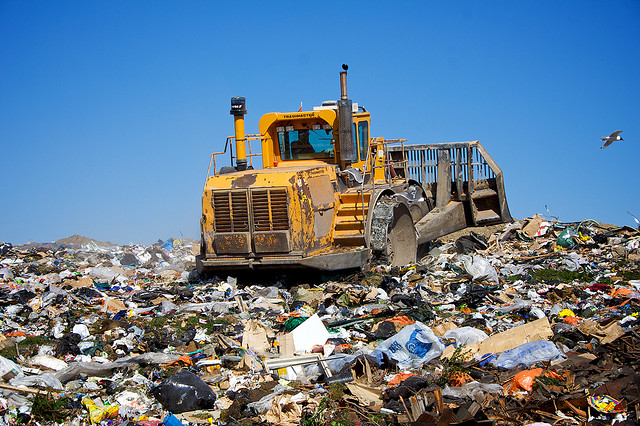
Landfill liners prevent leakage of fluids that could contaminate water. Photo: D’Arcy Norman (Flickr)
In LaFontaine’s district, which is 50 miles north of Detroit, engineers have worked with the St. Clair landfill to research bioreactors and the necessity of the two-liner landfill system.
The Smiths Creek bioreactor plant is a section of the St. Clair landfill that took part in the research. A bioreactor is a landfill that degenerates the garbage faster than an average landfill with the introduction of liquids.
Liners are made of clay or man-made substitutes. Both have a flexible membrane of polyurethane and a liquid collection system, said Terri Zink, director of compliance services at CTI and Associates, Inc. The liners are expensive, costing up to $84,000 per acre.
CTI , an engineering firm that designed the Smiths Creek bioreactor plant, used a 3.5-acre plot of the St. Clair landfill to test the system. At this location, ten inches of clay under the landfill acts as a natural liner.
Much of Michigan has this natural clay liner, Zink said.
The bill, if passed, would not require areas with a large natural clay liner to have the second liner. It would be up to the Department of Environmental Quality to decide which areas are eligible for avoiding the double protection.
“We agree that we have to be protective. It’s critical that any of these landfills, whether bioreactor or not, have to protect ground water,” said Steve Sliver, chief of solid waste and land application in the Department of Environmental Quality. The Department helped write specific language in the bill and supports it.
To protect the Great Lakes, in 2005, the Michigan legislature, made the landfill requirements twice as strict as the federal requirement
The Michigan Environmental Council, a nonprofit coalition representing Michigan environmental groups, opposes the bill.
A lot of chemicals in landfills could leak out, said Hugh McDiarmid, communications director of the Michigan Environmental Council. A leak could hurt wildlife, affecting the fishing industry and tourism, McDiarmid said.
The bill is in the Natural, Resources, Tourism and Outdoor Recreation committee.
“I believe in protecting the environment but I also believe that people have to be in that environment so we have to find a balancing act to keep them both there,” said Rep. Peter Pettalia, R-Presque Isle, a member of the House Natural, Resources, Tourism and Outdoor Recreation committee. “I believe that science has to prove to me that one liner is not enough.”
Zink says the Smiths Creek bioreactor has proved to be just as safe the double-lined landfills.
The bill also removes a ban on liquids in certain landfills, Liquids were banned because they might cause runoff and contaminate fresh water.
“People are understandably concerned that’s going to put too much pressure on the liner and it’s going to leak out,” Sliver said.
The law allows only a certain amount of liquid to be in a landfill at one time to prevent leakage, Sliver said.
Adding liquids makes garbage decompose faster, Zink said.
Speeding this up allows more garbage to be put in a landfill, saves money on long-term maintenance and produces more methane gas that can be used to make energy, Zink said.
McDiarmid fears water contamination.
“Michigan is defined our water resources,” said McDiarmid.