Congress considers limiting states’ ability to regulate ballast water

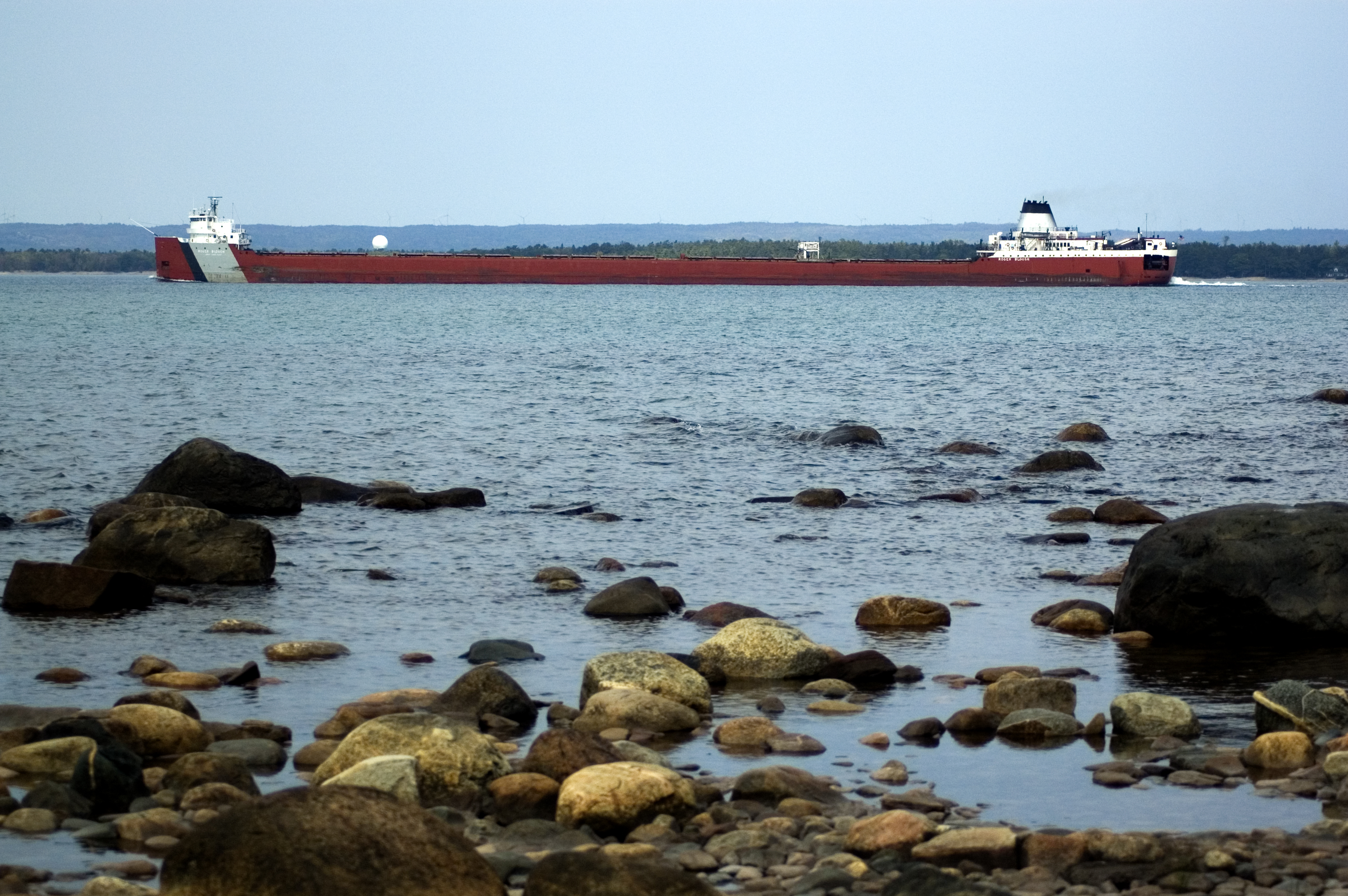
Freighter just through locks at Sault Ste Marie. Photo: Odalaigh via Flickr.
The U.S. House of Representatives is considering legislation to discourage states from regulating ballast water more strongly than federal rules.
Debate this week came after the House Appropriations Committee on Tuesday approved a budget bill amendment that would withhold Environmental Protection Agency funding from any state that did so.
The amendment, proposed by Steven C. LaTourette (R-Ohio), would particularly affect New York, as it is the only state that currently exceeds EPA’s standards, said Marc Smith, senior policy manager at the National Wildlife Federation, Great Lakes office.
The other seven Great Lakes states have adopted the federal Vessel General Permit, which requires ballast water to be swapped before entering the Great Lakes – but it’s not 100 percent effective, Smith said.
Ballast is water used to stabilize ships. It has a history of introducing invasive species into the Great Lakes.
The restriction on EPA funding is a powerful disincentive.
“The Great Lakes are obviously in tremendous need of restoration money … [The amendment] would take away the state’s ability to protect its own water from invasive species,” Smith said.
Hal Rogers, the House Appropriations chairman, disagrees and said a number of amendments on the Interior Appropriations bill are to encourage economic recovery.
“This legislation is a great example of the hard but necessary work the Appropriations Committee is doing to get our fiscal house in order by cutting extraneous, duplicative and unnecessary spending,” Rogers said in a press release.
The House debated the bill Wednesday; floor action is expected the week of July 25.

The John Kasich Republicans of Ohio have declared war on the health and welfare of the Great Lakes. Ohio natural resources and enviromental state field staff do not support the corruption of their Kasich administration, but are fearful for their jobs if they speak out.
Like or Dislike:
0
0
Our Michgan Republican legislators are just as corrupt. Don’t expect Gov. Snyder to do anything more than give phony lip service in defense of the Great Lakes.
Like or Dislike:
0
0
All ocean going ships should be required to unload in Lake Ontario, below Niagara Falls which historically was the natural barrier. There, they could be loaded onto ships that remain exclusively in the Great Lakes. That would cost a bit more, and it would necessitate more jobs, but that’s the only sure way to stop additional invasive species brought over by ocean going ships from entering the upper four Great Lakes.
Like or Dislike:
1
0
Big surprise! Gov. Kasich VETO! to this bad bill. Tea Party won’t like this……to be continued.
Like or Dislike:
0
0
The ocean flush dose not remove human bacteria and virus in sludge, cyst and bio films remaining in ballast tanks. No ballast on board dose not prevent these systems being used in the Great Lakes from introducing these problems and spreading existing ones already in the lakes. This is about American politicians of both party’s being bought by big money helping the shipping industry (which according to reports for Congress is comprised of mainly foreign flags) avoid cost by not requiring installation of the needed technology to insure safety of Americans health and environment. Lets hope New York’s governor, who has already delayed the timeline for NY regulations in conjunction with the Obama administrations Coast Guard delay plan, dose not cave in to political pressure after he spent NY taxpayer dollars developing and defending NY laws while he was attorney general. Those who care need to inform the public about this disregard for Americans health and environment before they set a precedent through laws that will likely remain in affect for decades. The general public is not aware of the danger these politicians are willing to impose on Americans, on behalf of foreign shipping interest and the major news media’s will not talk about issues that curtail economic globalization, regardless of the toll on human health such as the spread pollutants like tar balls, oil, nuclear waste water, or even cholera that ocean flush’s do not remove and may even promote.
Like or Dislike:
0
0
If this bill passes the House it will be interesting to see if California’s Senator Boxer will object to it and stop it the way she stopped HR.2830 in 2008 from authorizing the Coast Guard to protect the whole country from ballast water because of her alledged contention it would overide her states rights to stronger ballast water protection, especially since the state of California has since backed off from their strong stance on ballast water protection. Obviously any Senator could stop this bill from becoming law over state rights.
Like or Dislike:
0
0
If these lawmakers want to impose an economic penalty for a States right to control the amount of pathogens dumped in their waters will they do the same for a states rights to regulate pathogenic material in emmissions released into the air?
Like or Dislike:
0
0
http://readme.readmedia.com/New-York-Pursues-Uniform-National-Ballast-Water-Requirements/3642280
reportedly NY has caved in
Like or Dislike:
0
0
Leave your response!
Special Reports
Recent Comments
“http://readme.readmedia.com...”
Congress considers limiting states’ ability to regulate ballast water
“In Michigan the Republicans make sure the manure zombies remain in the waterways on behalf...”
Keep the undead out of your drinking water
“Kara: Michigan has more Great Lakes shoreline than the other seven...”
New Year’s resolution: There are only five Great Lakes states
“I’m pregnant and my OB/GYN told me not to eat ANY Michigan or...”
Mercury in newborns likely from mothers eating contaminated fish
“Frankly, I would much rather see deer starve in a severe winter...”
Mild winter helps Upper Peninsula deer find food, avoid predators
News archive
Submit a story
Great Lakes Tweets
Interact
Other Resources
Most Commented
Who We Are
Great Lakes Echo is a project of the Knight Center for Environmental Journalism at Michigan State University.
Additional content provided by MSU's Capital News Service.
Technical assistance by MSU's Department of Telecommunications, Information Studies and Media with support from the Michigan Agricultural Experiment Station.