
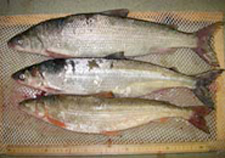
The native reef cisco has reappeared in Lake Michigan in recent years. Photo: Michigan Department of Natural Resources.
By SARA QAMAR
LANSING – Thought to have been a lost genetic strain of native fish, the reef cisco has reappeared in Lake Michigan in increasing numbers after 20 to 30 years out of biologists’ view.
The reef cisco was first seen again by chance in 2004 when 10 adult spawners were detected in Lake Michigan. Since then, the numbers have doubled annually, with 140 found last year, said Randy Claramunt, a Department of Natural Resources (DNR) fisheries biologist in Charlevoix.
Its reappearance is important from the standpoint of restoring a strain of a native species, he said.
“If you look at Lake Michigan fish management goals, it’s to provide a diverse fishery. And many people think reef cisco will be a key component in the diversification and stabilization of the fishery,” he said.
Amid troubles with invasive species in the Great Lakes, the increase of reef cisco is welcome news, said Pat Rusz, the director of wildlife programs at the Michigan Wildlife Conservancy in Bath.
“We mostly get bad news with fish populations. This is a case where a native strain of cisco that is thought to have been gone because of the impact of exotic species like smelt has, in fact, bounced back,” he said.
“Invasive species are a number-one problem. Biological pollution caused by exotic species is probably more harmful to the environment than chemical pollution that everyone thinks about,” Rusz said.
The reef cisco, which are concentrated in East Grand Traverse Bay, primarily eat smelt and have increased enough to establish themselves in the ecosystem, he said.
Limited amounts of smelt, however, may be a deciding factor in whether the reef cisco prospers, he said.
Commercial anglers in the lower Great Lakes must throw reef cisco back into the water. Recreational fishers, however, are allowed to keep 12 a day, which is the same limit as other forms of the species, said DNR’s Marquette communications representative, Debbie Munson Badini.
Another obstacle to their survival lies with the fish’s reproduction grounds — reefs – that could be in danger from human activity, he said.
“From time to time there are proposals to modify the shoreline,” which affects the flow of lake currents and shifts sand, which could plug the reefs, Rusz said.
On average, a reef cisco can grow to more than 6 pounds. Other cisco are substantially smaller.
“When you have genetic behavioral differences, you have better chances for the species to survive long-term. It’s encouraging that as we’ve seen many kinds of diversity diminish over the years, here’s an example of a form hanging on,” Rusz said.
Even so, the species is likely to remain unfamiliar to the public.
“A lot of people in Michigan will never see a reef cisco. Many of the kids growing up in Michigan will eventually grow old and they still will not ever see one, but it’s good to know that nature and evolution is still at work,” he said.