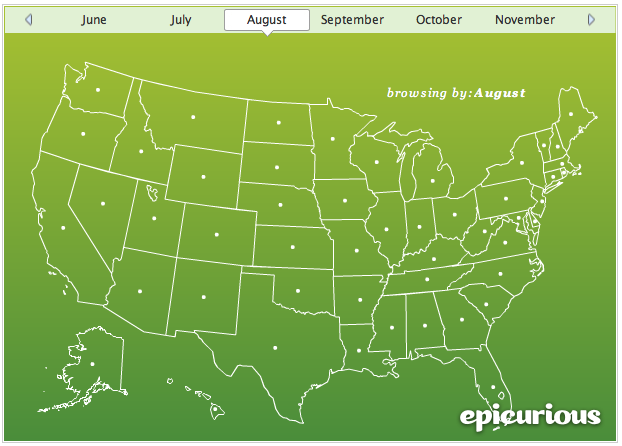
The "seasonal ingredient map" from epicurious.com shows what foods are grown locally in various states during each month.
Some things are simply easier to do when it comes to living more environmentally conscious. Some activities are more time consuming, some more expensive and some just demand too much of a change in lifestyle.
For many, food is where the line is drawn.
If residents in the Great Lake states can’t have an orange for lunch in December because it is neither local nor seasonal, it might be where they bend their “environmentally friendly” rules and lifestyle.
“Seasonal” and “local” are buzzwords that define sustainable eating practices. The idea is that by eating food closer to home and in season, a person reduces how far food travels to reach their plate. The fewer miles the food travels, the less carbon dioxide is released into the atmosphere through transportation, thus mitigating global warming.
However, according to the “Seasonal Ingredient Map” from epicurous.com, its clear that practicing this is much easier in some parts of the country than others.
This mashup shows what fruits and vegetables are sustainable in each state for each month. Click on a month at the top and then choose a state to find out what kinds of produce are sustainable at that time. For instance, September in the Great Lake states is abundant with produce as diverse as okra, watermelon, pumpkins, Asian pear and cucumber. Each time you click on a certain produce item, the map also provides recipes using the ingredient.
Alas, move past the fall months in the Great Lake states and the list of seasonal items shortens. In fact, throughout December, January and February, nearly all of the Great Lake states don’t have anything listed as seasonal. For those of us living in the area, we already know that you can’t grow anything during those months and don’t need a map to tell us. However, clicking around other states in the US during those months can show you where the grapes, oranges and lettuce you are buying at that time, are really coming from.
And that can inform your attempts to buy in an environmentally friendly manner.